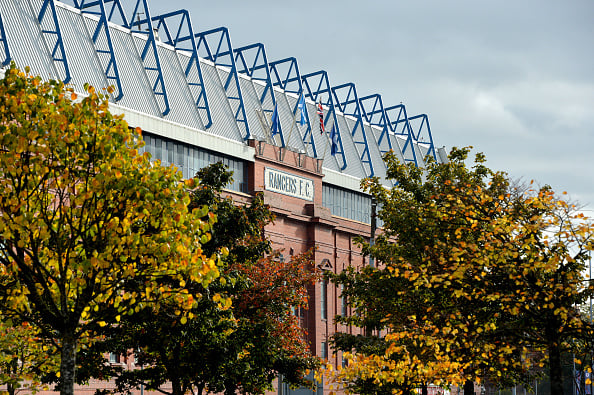


Some Rangers fans have been calling for Ibrox Stadium to be expanded to meet demand for tickets from the Rangers faithful.
And they’ve been dreaming up some pretty inventive ways to do it.
Ideas range from the money-spinningly ludicrous knocking down and rebuilding of three stands, to the more conservative safe standing or adding of another tier to the Copland Rd. There’s a great thread on Follow Follow here.

Rangers have a high demand for season tickets with that demand only set to increase if the club can secure the coveted 55.
It’s certainly seems all talk at the minute – but would it actually be feasible?
After all, developments are nothing new at Ibrox (see timeline at the bottom of this article).
What are fans suggesting?
Fans are suggesting a variety of potential options for expansion. Largely they come from the fact Rangers have sold over 45k season tickets this season. These are record breaking sales.
There have also been rumours of a several thousand strong waiting list.
See a thread with a prominent journalist below. Ignore the responses from our friends to the East.
A lot of the musing suggests moving the TV Screens, building new tiers upon the Govan, Copland and Broomloan stands, or squeezing in more seats in the corners.
There’s a general feeling among the support that any expansion is when rather than if.
When it come to Safe Standing, it’s not so much about increasing capacity as it is about the matchday experience. Joe.co.uk spoke to Jon Darch of the Safe Standing Roadshow who explains that Spurs built safe-standing capabilities into their stadium, but it would only “increase by c 1800 were legislation to change and safe standing areas approved.”
Is expansion possible?
Very much so – at least according to the last two resident Ibrox Chairmen.
Expansion is part of a wider refurbishment of the surrounding area and stadium. Not to mention the reiterations of a match day improvements for fans.
Dave King spoke positively of refurbishment plans for the 150th Anniversary Celebrations.
“There are areas – roofs, within the stands, painting – there’s a whole bunch of things that we need to be doing there.
“As far as improvements are concerned, we’ve got some very ambitious plans, both on our own and working with the council for project 2022.
“We’re looking at complete improvement and refurb of the surrounds of the ground and really redeveloping the stadium completely.
“And that would be a very, very significant improvement in terms of the matchday experience for fans.”

King told RangersTV : “A lot of the work we’ve done over the last couple of years has probably not rightly been termed ‘improvements’.
“I think what we’ve done is refurbishing and repairing a stadium that had become dilapidated to get it back to being fit for purpose and something Rangers supporters should be proud of.
“We’ve spent a lot of money on that side and we’ve already committed another several million to improving it.”
Not much on an expansion, but promising investment into Ibrox is certainly happening.
Charles Green said in 2013 that “the way the ground [Ibrox] is configured, there is a great opportunity to fill in the two corners and put another Club Deck on the Govan Stand.”

But we’ll take what he says with a pinch of salt.
However, it does make us believe it is very much possible.
Financial implications
The best point of comparison is at home with Aberdeen and Hearts. Both clubs are smaller than Rangers but have supplied major investment into their stadia in recent years.
Aberdeen have been given the go-ahead to build a new 20,000 seater stadium with estimated costs reaching a whopping £50m. According to the Daily Record they’ve only so far secured £7m of this but are confident they can get the rest.
Hearts have just spent £15m on a new stand. Up to £4.5m of this came from mystery benefactors. They’ve done it and secured minimal debt. It’s a major achievement for the club.
We can learn from them.

If these clubs can do it, why can’t Rangers?
We have a bigger support, we have higher earning potential, and as far as attendances are concerned we have larger room to grow.
But any redevelopment on the stadium would undisputedly represent a significant investment.
How much would it cost? Well that depends on the development and it is largely not for me to say, but if the club is ambitious it has to be considering this. Going by the earlier words of Dave King, it won’t be too far from his mind.
Arguments against
Without howling Sevco, the main argument against is finance. Do Rangers have the money for a major stadium redevelopment? Moreover, can they afford to do it in the midst of Celtic’s 10 in a row charge?
If the choice in the short term is a bigger stadium or success on the pitch, the answer is obvious. Getting back to the top of Scottish football comes first. Any expansion is just a small part of that.
Rangers still haven’t released this season’s kits. We’ve just invested significantly in the playing squad. We’re rebuilding our squad. Money, which is more difficult to come by for us than others, is better spent elsewhere at present.

That doesn’t mean we can’t dream. From what’s available and from what the club has said, expansion at Ibrox is a very real prospect at some point in the future.
Fans I’m sure would dig deep to help out. Rangers pools anyone? They famously helped raise money for a major development in the last 70s and early 80s.
What do you think about the potential Ibrox Stadium expansion?

A timeline of Ibrox history…
1899
Rangers move to the current site of Ibrox Stadium, or Ibrox Park as it was known post-1997. It was almost completely different to the Ibrox of today.
1902
Capacity increased to 75,000 by the construction of wooden stands. Tragically, one of these collapses in in a Scotland v England game in 1902, leaving 25 people dead.
1910
New design increases capacity to 63,000. At this time Scotland had the three largest purpose-built football stadia in the world.
1929
Famous Main Stand with red-brick façade opens on Jan 1st. It was designed by Archibald Leitch.

1939
The banking of terracing and increasing of capacity continued into the late 30s. In this year 118,567 attend an Old Firm – the record attendance for any British league match.
1953
Floodlights used for first time in friendly with Arsenal. First floodlights in a Scottish league match were at Ibrox in 1956.
1961
Tragedy strikes Ibrox again as two fans are die as a barrier collapses on Stairway 13. This is the first of a decade of tragedies for the stadium and club.
1968
Main Stand catches fire twice in seven months.
1971
The Ibrox Disaster sees 66 people die in a crush on Stairway 13 after an Old Firm. The tragedy played a big part in bringing in the Safety of Sports Grounds Act 1975.

1981
The new 44,000 capacity Ibrox opens. Rangers took a huge and important financial risk to build a safe, modern stadium for supporters, demolishing old parts of the ground for the new. It would cost up to £10m and deplete the club financially. Rangers fans helped fund it through the revolutionary Rangers football pools.
1987
Famous Main Stand given Category B Listed Building status, preserving it’s future.
1990
Argyle House, an extension behind the Govan Stand, is opened by David Murray. This £4m development added executive boxes, office space and hospitality suites.
1991
The Club Deck, an approx. £20m investment on top of the Main Stand, opens to the fans.
1997
Ibrox Park renamed Ibrox Stadium after range of minor developments pitchside and in the corners raise capacity to just over 50,000.
2006
Main Stand renamed Bill Struth Main Stand to commemorate 50 years since his death. Three rows of seating were also added to the Govan Stand to accommodate Bar 72.
2014
Govan Stand after Club Legend and life-long servant Sandy Jardine.